
Nigeria's Innovation Ranking Tells a Story. Are We Honest Enough to Read It?

In 2025, Nigeria ranked 105th out of 139 countries on the Global Innovation Index — an improvement of 8 places from 113th the previous year. [1] WIPO named Nigeria one of the fastest climbers in this year's report. The country also ranked 1st globally in unicorn valuation, a measure of high-value tech startup activity.
These are real achievements. They deserve acknowledgement.
But context matters. Here is Nigeria's full trajectory on the index over the past six years: [2]
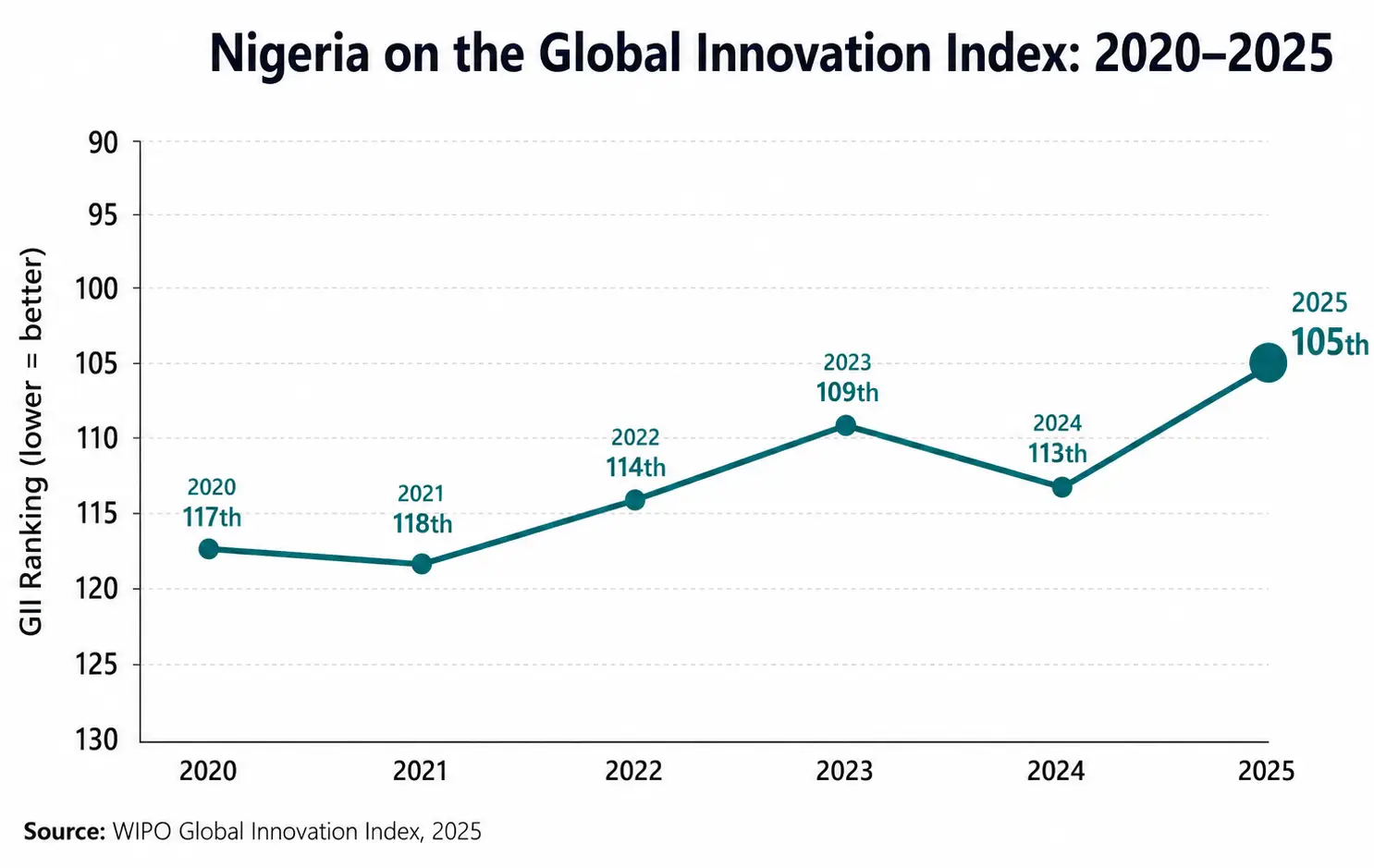
The pattern is not a steady climb. It is a volatile drift — years of marginal movement punctuated by a more significant jump in 2025. Whether that jump represents a turning point or a single good year will only be visible in the years ahead.
What is not in dispute is where Nigeria still stands: 105th out of 139 countries. And Nigeria is not alone. Across the continent, the gap between what universities produce and what economies need is one of Africa's most consistent and consequential challenges.
The Global Innovation Index (GII) — published annually by the World Intellectual Property Organization (WIPO) — ranks countries by their capacity to generate and sustain innovation. [1] It measures institutions, human capital and research, infrastructure, market sophistication, business sophistication, and knowledge outputs. It is, in effect, a composite picture of whether a country's systems are producing people who can create, build, and solve problems at scale.
Nigeria's 2025 score of 21.1 out of 100 is an improvement on the 17.1 recorded in 2024. The world average is 31.49. [3] We are making progress. We are still significantly below the global average. Both things are true — and the same can be said of most African economies.
What Singapore Understood
Singapore has no oil. It has no vast farmland. It is a city-state smaller than Lagos with a population roughly equivalent to Ibadan. By most conventional measures of resource endowment, it should be unremarkable.
In 2025, Singapore ranked 5th on the Global Innovation Index — behind only Switzerland, Sweden, the United States, and South Korea. [1]
The difference between Singapore and Nigeria is not natural resources. It is not geography. It is a deliberate, sustained, decades-long investment in the quality of human capital — across every professional discipline.
Singapore made a decision, early in its development, that the people who run things matter more than the things already in the ground. They built an education system oriented not just toward credentials but toward competency. Not just toward passing examinations but toward producing professionals — doctors, accountants, engineers, lawyers, technologists — who could apply knowledge to real problems, with real tools, in real conditions.
Nigeria has not yet made that decision consistently, at scale. And the index, year after year, reflects it.
The African Skills Gap Is a Continental Problem
Nigeria's experience is not unique. It is emblematic.
A 2024 survey conducted by the African Leadership University across nine African countries — Côte d'Ivoire, Ethiopia, Ghana, Kenya, Nigeria, Rwanda, South Africa, Uganda, and Zimbabwe — found that while 68% of employers believe higher education institutions are broadly preparing graduates for the job market, significant gaps remain in the skills they actually need. [4] More than half of employers agreed that workers will need to reskill multiple times throughout their careers — a direct indictment of how durable current graduate training actually is.
The picture is sharper still when you look at digital skills. The World Bank's Africa Human Capital Technical Brief found that only 11% of Africa's tertiary graduates have formal digital training, yet approximately 65% of new hires at surveyed African firms already require at least basic digital skills. [5] The gap is not marginal. It is structural.
Across the continent, surveys indicate that over 75% of African employers express concerns about the inadequacy of graduate skills — while universities continue to produce graduates whose qualifications are misaligned with what the labour market actually demands. [6] The African Development Bank puts a specific number on one dimension of this mismatch: 28.9% of employed African youth are in roles that their qualifications exceed — working below their credential level, not because they lack ambition, but because the system produced the wrong preparation. [7]
This is the paradox of African higher education in 2025. Enrolment is rising. Graduation rates are improving. And employers, consistently, across countries and sectors, say graduates are not ready.
The Human Capital Gap Is Not Abstract
It is worth being specific about what "human capital" means in practical terms, because the phrase can obscure more than it reveals.
It means accounting graduates who have studied financial reporting for four years but cannot navigate the software their employers run daily. It means medical graduates who understand pharmacology in theory but struggle when a real ward presents without a textbook structure. It means technology graduates who can describe algorithms but have never shipped a product. It means business graduates who passed every management paper but cannot contribute meaningfully in their first six months at work.
Employers across sectors — from financial services to healthcare to manufacturing to construction — report the same pattern across the continent. The graduates arriving at their doors are academically capable. They are not professionally ready.
Nigeria's 2025 GII result is telling on this specific point. The country ranked 127th in innovation inputs — the institutional and educational infrastructure that is supposed to generate innovation — but 80th in innovation outputs. [2] Nigerian graduates are overperforming relative to the education system they came through. That is a remarkable thing. It means Nigerian professionals are resourceful and resilient in ways that formal systems do not fully capture.
But it also means the continent is leaving an enormous amount on the table. With better inputs — with education that actually bridges theory and practice — the output ceiling is far higher than where it currently sits.
What AfCFTA Changes — And What It Demands
The African Continental Free Trade Area, which began implementation in 2021, is the most significant structural shift in Africa's economic architecture in a generation. Connecting 1.3 billion people across 55 countries with a combined GDP of approximately $3.4 trillion, AfCFTA creates the conditions for a single continental market for goods, services, capital, and — eventually — people. [8]
That last point is the one that matters most for universities and graduate employers.
A continental labour market means a Nigerian accountant may compete for opportunities in Rwanda. A Ghanaian engineer may be assessed against candidates from South Africa and Kenya. A Kenyan lawyer may need to demonstrate competency standards that satisfy firms operating across multiple jurisdictions. The question of what a graduate can actually do — not just what their certificate says — becomes a continental question, not a national one.
The AfCFTA will only deliver its potential if African graduates are genuinely competitive — not just within their countries but across the continent. The Global Partnership for Education has been explicit on this point: AfCFTA will live up to its promise only if Africa invests in the kind of education reform that produces graduates with real 21st-century skills. [9] At present, the skills mismatch that exists within individual countries represents a ceiling on what the free trade area can actually achieve.
For university departments, this is not an abstract concern. It is a signal about where the bar is moving — and how quickly.
What Agenda 2063 Requires
The African Union's Agenda 2063 — the continent's 50-year blueprint for development — is unambiguous about the role of education in Africa's future. It calls for "an education and skills revolution emphasizing innovation, science and technology," and envisions an Africa of 2063 where harmonised education and professional qualifications systems exist across the continent, and where millions of Africans have been trained with "special emphasis on science, technology, research and innovation, as well as vocational training in every sector." [10]
The vision is compelling. The implementation challenge is significant.
The Continental Education Strategy for Africa (CESA), the AU's ten-year education framework, explicitly calls for a paradigm shift toward "transformative education and training systems" that meet the knowledge, competencies, and skills required by African economies. [11] That shift — from credential-focused to competency-focused education — is precisely the gap that most African universities have not yet crossed.
COREN's recent pivot toward outcome-based education in Nigeria, formalised through Nigeria's provisional Washington Accord membership in 2023, is one example of a professional body trying to force that shift from the regulatory side. [12] But regulatory frameworks and curriculum reality do not always move together. The framework is right. The implementation, across the continent, is the challenge.
The Countries Moving Past Nigeria — and Africa
While Nigeria moved 8 places in 2025, others were moving faster and from a higher base.
India climbed to 38th on the 2025 GII. Vietnam reached 44th. Within Africa, South Africa holds 61st, Senegal reached 89th, and Rwanda — the continent's most consistent innovation over-performer — sits at 104th, just ahead of Nigeria. [1]
Morocco, at 66th, deserves particular attention for African policymakers. It is a middle-income African economy that has made deliberate, sustained investments in aligning its university system with the needs of its industrial and services sectors. The results are visible in the index. They are also visible in the foreign direct investment Morocco continues to attract.
The lesson is not that Nigeria or any other African country should copy Morocco or Vietnam. The lesson is that deliberate alignment between education and industry produces measurable results — and that absence of alignment produces measurable stagnation.
Nigeria graduates more university students every year than many of these countries. Africa as a whole has one of the fastest-growing graduate populations in the world. The question is not quantity. It is what those graduates can do on the day they arrive at work.
What This Means for Lecturers and Institutions
The GII ranking is not a judgement on African graduates as people. It is a signal about systems.
Lecturers across African universities are, in large part, working within structures they did not design and cannot unilaterally change. National accreditation requirements, government funding constraints, departmental resources, and administrative pressures all shape what is possible in any given classroom. The problem is structural, and structural problems require structural solutions.
But structural change in African higher education is slow. It happens at the level of individual departments, individual lecturers, and individual decisions about what to prioritise. The lecturers who are choosing to bring real-world case studies into their courses, who are building relationships with industry practitioners, who are asking what their graduates actually need to be able to do — those lecturers are not waiting for a policy directive. They are making a decision that their students' practical readiness matters.
That decision has ripple effects. Graduates who leave a department able to apply their knowledge from day one do not just benefit themselves. They represent that department in the labour market. They become the evidence — or the absence of evidence — that the system is working.
The ALU 2025 Africa Workforce Readiness Survey found that 51% of school leavers across Africa said the opportunity to gain work experience during their studies was a main priority when choosing where to study. [4] Students already know what they need. The question is whether institutions are listening.
One Good Year Is Not a Strategy
Nigeria's 2025 GII result is the best news in years. Eight places in twelve months. A global top ranking in unicorn valuation. Recognition as one of the fastest climbers in the world.
If this is the beginning of a sustained shift — driven by better alignment between education and industry, stronger institutional frameworks, and more deliberate investment in graduate competency — then the next decade could look very different from the last one. Not just for Nigeria, but for Africa's regional competitiveness as AfCFTA opens up.
But one year is one year. The trajectory from 2020 to 2024 was not a success story. And across the continent, the pattern of talented graduates in systems that were not designed to prepare them fully for professional life remains the defining challenge of African higher education.
The World Bank projects that Sub-Saharan Africa will need to create 25 million new jobs annually over the next quarter century to keep pace with its growing labour force. [13] Those jobs will require professionals who can contribute meaningfully from day one — not graduates who spend their first year being retrained.
105th is better than 113th. It is not good enough. And it is one country's number in a continental challenge that demands a continental response.
The honest accounting continues.
Circonspect is an AI-powered learning platform bridging the gap between academia and industry in Nigeria and across Africa.
References
World Intellectual Property Organization (2025). Global Innovation Index 2025: Results. WIPO. Read more...
World Intellectual Property Organization (2025). Global Innovation Index 2025: Nigeria Economy Profile. WIPO. Read more...
TheGlobalEconomy.com (2025). Nigeria: Global Innovation Index score, 2025. Read more...
African Leadership University (2025). ALU 2025 Africa Workforce Readiness Survey Report. ALU. Read more...
World Bank (2023). Digital Skills to Accelerate Human Capital for Youth in Africa. World Bank Group. Read more...
The African Mirror (2025). Bridging the skills gap: Tackling Africa's skills mismatch crisis. Read more...
Global Business Outlook (2026). Africa's graduates stuck in limbo. Read more...
World Bank (2023). The African Continental Free Trade Area. World Bank Group. Read more...
Global Partnership for Education (2021). Education: A key to the success of the African Continental Free Trade Area (AfCFTA). Read more...
African Union Commission (2015). Agenda 2063: The Africa We Want — Framework Document. African Union. Read more...
African Union (2016). Continental Education Strategy for Africa (CESA 16–25). African Union. Read more...
Council for the Regulation of Engineering in Nigeria (2023). Press Briefing: COREN's Washington Accord Provisional Signatory Status. COREN. Read more...
Economic Policy Research Centre (2025). Are Skills Mismatches Fuelling Africa's Youth Unemployment Crisis? Read more...
How did you find this article?
1 reaction
The Circumspect
Circonspect contributor
The Circumspect Review
Stay informed on Nigerian engineering education
Join engineering students, lecturers, and industry professionals who read The Circumspect Review every month.
No spam. Unsubscribe anytime.